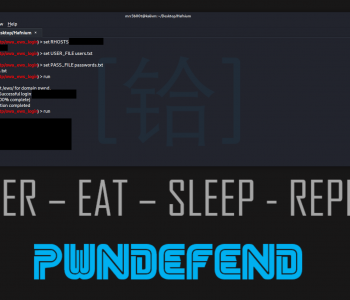
Password Spraying/Credential Stuffing OWA with Metasploit Framework

Ok so this is not very ‘1337’ but it will get the job done (and that is what is important, no one cares how they get pw3d they just care they were). If you really wanted, you could hand craft this in python of another language or use another tool (script etc.)

Do start with we are going to need a username list and a password list (as well as a target IP or DNS name). This could be:

  • Obtained via OSINT
  • Obtained via stolen/breached credentials
  • Dictionary Created
  • Password Lists could be used/generated etc.

We also need to have considerations for account lockouts. If we are doing a penetration test, then we will have to likely avoid DoS. If we are doing a ‘RED TEAM’ or adversary simulation, then we will want to avoid being noisy and getting caught. (If we are doing monitoring and detection testing you probably want to be quiet and noisy ala control testing). Read more “Password Spraying/Credential Stuffing OWA with Metasploit Framework”

ProxyLogon – A god mode backdoor even when used…

Imagine

Imagine being able to read emails from any mailbox from a corporation! But everyone uses office 365… don’t they? Well ok even if that was the case (It’s not) then the RCE would come into play. An RCE into system level access to Exchange which is so heavily tied to active directory they are almost joined at the hip) is a killer foothold. However, you pain the scenarios they aren’t good!

All knowing and all powerful

Imagine if you could read everyone’s email! What could you do with this?

  • Steal IP
  • Steal data
  • Steal credentials
  • Extort, blackmail and bribe

The SSRF vulnerability enabling a threat actor to gain unauthenticated read access to mailboxes would be a killer tool for both nation state spies and criminals alike. Read more “ProxyLogon – A god mode backdoor even when used with READ only”

Thoughts on IOCs for Exchange Hafnium/ProxyLogon

Intro

This isn’t a rant, far from it but I’ve been working on this for over a week now and some major questions are sprining to mind with regard to how the IOCs and detection details released may have hindered response efforts. These vulnerabilities were known about since at least December 2020, there were months to get detection intel and scripts/tools ready for people (that’s if you don’t question why did it take so long). So I’ve put some of my thoughts down here on some of the challenges with the IoCs initially released and the detection tools etc. I’ll probably update this later but wanted to publish it before it becomes virtual dust! Read more “Thoughts on IOCs for Exchange Hafnium/ProxyLogon”

Hafnium / Exchange Marauder High Level IR Help

Ok so John and I have been working on this for a while. We have been working with both customers and industry profesionals and there’s a common theme. Understranding the events from this incident are quite challenging because:

  • We don’t have sample log output for known bad traffic
  • The vulns can be used for data theft and/or backdoors (and further actions on target)

Getting guidance out so far on this has been challenging becuase:

  1. There is not a public full kill chain POC to do comaprisons to (i’m ok with that)
  2. We don’t have a pw3d server that has all the indicators from all the routes on

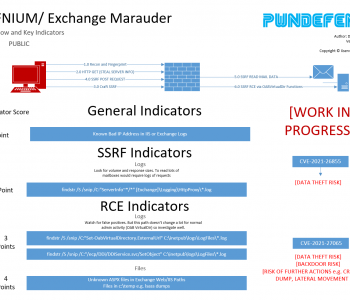
So to try and help people we have made a diagram which we will update as we go.

Essentially you need to perform a weighted analysis to understand if:

  • You had recon only
  • You had some SSRF
  • YOu had SSRF that led to data theft
  • You had a webshell planted
Read more “Hafnium / Exchange Marauder High Level IR Help”

Checking for Hafnium or other groups impact from Exchange…

Introduction

On March 2nd, 2021 at ~6pm GMT Microsoft released an out of band update to all version of exchange from 2010 through to 2019. This was in response to a range of vulnerabilities which had been abused (a 0-day) by a threat actor (coined by MS as HAFNIUM).

For more info from MS please see the following:

https://www.microsoft.com/security/blog/2021/03/02/hafnium-targeting-exchange-servers/

Key CVEs

Key CVES include:

CVE-2021-26855, CVE-2021-26857, CVE-2021-26858, and CVE-2021-27065. Read more “Checking for Hafnium or other groups impact from Exchange Abuse”

Exchange 2010 Rapid Analysis for IOCs

Purpose

With the Hafnium “incidents” and Exchange vulnerabilities I wanted to help people with ruling in or out compromise of their Exchange 2010 environments. At the time of writing, I don’t believe that Hafnium affected Exchange 2010 via the reported kill chain, I believe that BEC would be required but this is a theory, my general view is Exchange 2010 might be ‘safe’ from this kill chain. This is due to the initial stage leveraging CVE-2021-26855 which is an SSRF vulnerability which only affectes the new architecture (2013+). However, this is an unsupported platform so I wanted to help with some baselines and talk about how I would approach ruling compromise in or out (at least with regards to these vulnerabilities). The key impact area is a web shell. I’ve made some baselines to help people look for abnormalities.

Disclaimer

This document was made with limited time and without full Whitebox access to source code and engineering expertise. The areas we are checking for IOCs appear to make logical sense, but the OS and APP (Exchange 2010) are unsupported, and we are not the vendor. So, I am afraid your hunting responsibility is on you, this is just my opinions and thoughts from a very fast analysis. Use at your own risk. Read more “Exchange 2010 Rapid Analysis for IOCs”

How to enable NULL Bind on LDAP with Windows…

History of NULL bind

Back in the early Active Directory days NULL bind was actually enabled by default, these days you can get a rootDSE NULL bind out of the box but on Windows Server 2019 you can even disable this!

So why would I want to enable NULL bind? Well, some legacy apps may need it but generally speaking you don’t want NULL bind enabled.

The lesson here is DO NOT copy what I am doing here! Simples! Read more “How to enable NULL Bind on LDAP with Windows Server 2019”